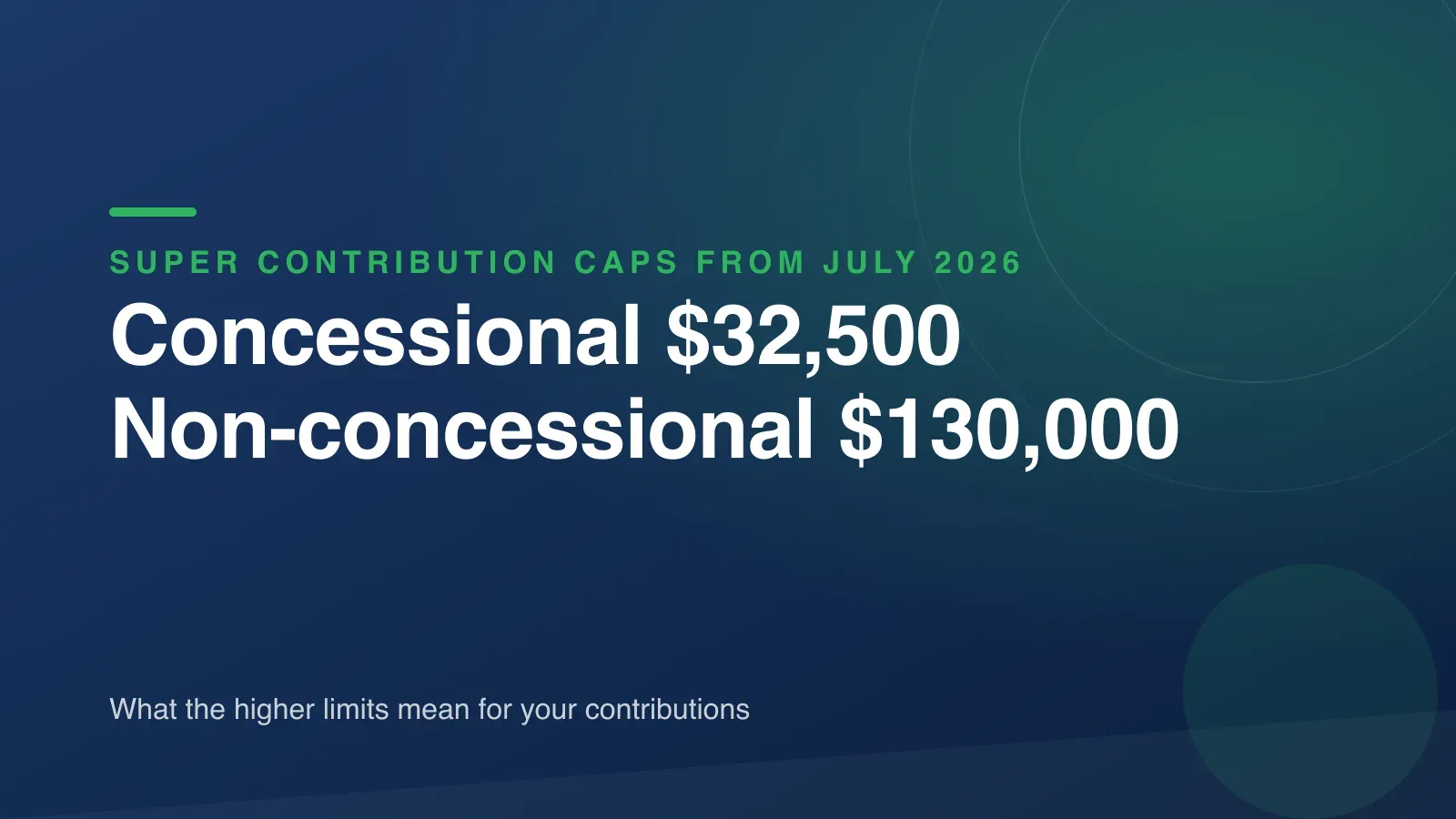
From 1 July 2026, Australia’s key superannuation contribution caps increased, giving eligible taxpayers more room to contribute to super without exceeding the standard contribution limits. The concessional cap is now $32,500, while the non-concessional cap has increased to $130,000, with eligible taxpayers potentially able to contribute up to $390,000 under the bring-forward rules.
The legislation provides for the concessional contributions cap to be indexed and sets the general non-concessional cap at four times the concessional cap. This produces the $130,000 non-concessional cap for 2026-27.
What are concessional contributions?
Concessional contributions are generally contributions made to super from before-tax income, or personal contributions for which you claim an income tax deduction.
They can include:
- compulsory employer Superannuation Guarantee contributions
- salary sacrifice contributions
- additional employer contributions
- personal super contributions that you successfully claim as a tax deduction.
From 1 July 2026, the general concessional contributions cap is $32,500 per financial year, up from $30,000 in 2025-26. The ATO also uses the new $32,500 cap in calculating the 2026-27 maximum super guarantee contribution base.
Concessional contributions are generally taxed at 15% in the super fund. For some higher-income taxpayers, however, Division 293 may impose an additional 15% tax on certain concessional contributions where the relevant income threshold is exceeded.
Remember: employer super counts towards your cap
A common misunderstanding is that the $32,500 limit applies only to voluntary salary sacrifice or personal contributions.
It does not.
Your employer's compulsory super contributions generally count towards the same concessional cap.
For example, assume an employee receives $18,000 of employer super contributions during 2026-27. If they have no other concessional contributions and no available carry-forward amounts, they would generally have $14,500 of their standard $32,500 cap remaining.
That is why it is important to check contributions already made or expected to be made by your employer before making a large additional deductible contribution.
Can you contribute more than $32,500 using unused caps?
Possibly.
The carry-forward concessional contribution rules allow eligible taxpayers to use unused concessional cap amounts from the previous five financial years.
To access unused amounts, your total superannuation balance immediately before the start of the financial year must be less than $500,000.
Unused amounts are available on a rolling five-year basis, with the oldest unused amount applied first when needed.
This can be particularly relevant where your income varies from year to year, you have not previously maximised your concessional contributions, or you are considering making a larger personal deductible contribution.
However, your available carry-forward amount is personal to you. It depends on your contribution history and total super balance, so the $32,500 general cap should not automatically be treated as your final personal limit.
Personal deductible super contributions
You may be able to make a contribution from your own money and claim an income tax deduction for it.
Once a valid deduction is claimed, the contribution generally becomes a concessional contribution and counts towards your concessional contributions cap.
Importantly, making the contribution alone is not enough. You generally need to provide your super fund with a valid Notice of intent to claim or vary a deduction for personal super contributions and receive the fund's acknowledgement before claiming the deduction in your tax return.
The ATO states that the notice generally must be provided by the earlier of:
- the day you lodge your tax return for the year in which you made the contribution, or
- the end of the following income year.
Other eligibility conditions also apply.
Non-concessional contributions increase to $130,000
The annual non-concessional contributions cap increased from $120,000 to $130,000 from 1 July 2026.
Non-concessional contributions are generally personal contributions made from money on which income tax has already been paid and for which you do not claim a tax deduction.
Unlike concessional contributions, they are generally not taxed again as contributions when received by the super fund.
Under the tax legislation, the general non-concessional cap is four times the general concessional cap:
$32,500 × 4 = $130,000
The amount you personally can contribute may, however, be lower or even nil depending on your total superannuation balance and whether you are already in a bring-forward arrangement.
The bring-forward rule: potentially up to $390,000
The increase in the annual non-concessional cap also increases the maximum amount available under the bring-forward arrangement.
For 2026-27, an eligible person may potentially contribute up to $390,000, representing three years of the $130,000 annual cap.
The legislation allows the bring-forward arrangement where the required conditions are satisfied, including the age and total super balance requirements.
The maximum $390,000 amount is therefore not available to everyone.
What happens if you exceed the contribution caps?
Contribution caps matter because exceeding them can create additional tax and administrative consequences.
For excess concessional contributions, the excess is generally included in your assessable income, with a tax offset recognizing the 15% contributions tax already paid by the super fund. There are also rules allowing eligible excess amounts to be released from super.
Different rules apply to excess non-concessional contributions, including options that may involve releasing the excess and associated earnings.
This is why making a large contribution without first checking your cap position can create unnecessary complications.
Before making an additional contribution
Before transferring a significant amount into super, it is worth confirming:
- your employer contributions already received or expected for the year
- any salary sacrifice arrangements
- personal contributions for which you intend to claim a deduction
- unused concessional cap amounts from earlier years
- your total superannuation balance at 30 June 2026
- whether you are already within a bring-forward arrangement
- contributions made to all of your super funds, not just one account
- whether a Notice of Intent is required for a proposed tax deduction.
Example: using the higher concessional cap
Sarah receives $20,000 in employer concessional super contributions during 2026-27.
Assuming she has no other concessional contributions and does not use any carried-forward cap, her remaining general concessional cap would be:
$32,500 − $20,000 = $12,500
If Sarah makes a $12,500 personal contribution and satisfies the requirements to claim a deduction, her total concessional contributions would reach $32,500.
Whether making that contribution is appropriate for Sarah is a separate decision and depends on her circumstances, but calculating her available contribution cap first helps avoid unintentionally exceeding the limit.
Example: using the bring-forward arrangement
Michael is 62 and has a total super balance of $1.20 million at 30 June 2026. He has not already triggered a bring-forward arrangement.
Subject to satisfying the other eligibility requirements, his balance is below the $1.84 million threshold for 2026-27, so he may be able to access a non-concessional cap of up to $390,000 over the three-year bring-forward period.
He does not have to contribute the entire amount in one transaction or in the first year. Any contribution decision should take into account his circumstances and the applicable super rules.
What the higher caps mean for you
The higher limits provide additional contribution capacity, but the headline numbers do not tell you how much you personally can contribute.
For 2026-27:
- the standard concessional cap is $32,500
- eligible taxpayers may have additional concessional cap available under the five-year carry-forward rules
- the general non-concessional cap is $130,000
- the maximum new bring-forward cap is $390,000
- total super balance, age and previous contribution history can significantly change the amount available.
The most important step is to check your personal cap position before the contribution is made, particularly where a large personal deductible contribution or non-concessional contribution is planned.
How SmartBridge Accounting can help
SmartBridge Accounting can assist with the tax and compliance aspects of superannuation contributions, including:
- reviewing concessional and non-concessional contribution amounts
- checking available carry-forward concessional caps
- reviewing bring-forward contribution limits
- assessing the tax deductibility of personal super contributions
- assisting with Notice of Intent requirements
- considering Division 293 tax implications
- identifying potential excess contribution issues
- assisting SMSF clients with contribution reporting and tax compliance.
Where your decision involves retirement planning, investment strategy, choosing a superannuation product or determining whether contributing additional money to super is appropriate for your personal financial objectives, you should consider advice from an appropriately licensed financial adviser.
Planning to make additional super contributions in 2026-27? Contact SmartBridge Accounting to review your contribution limits and the tax implications before you contribute.
General information disclaimer
This article contains general taxation and superannuation information only and is current as at 13 September 2026. It does not constitute personal financial, investment or legal advice and does not take into account your objectives, financial situation or needs. Superannuation and taxation rules are complex and individual circumstances vary. You should obtain appropriate professional advice before acting on this information.